 The
OpenBooks
Project
The
OpenBooks
Project
 A PAGE ON A PUZZLE
THE SEARCHES UNEARTHED
A PAGE ON A PUZZLE
THE SEARCHES UNEARTHEDThe Trustees' Musts gone missing
This wording in the
Archdiocese of Birmingham's Parish Financial &
Administration Guidelines and Procedures dated
March 2008 was also seen in more recent
documents from East Anglia and Arundel &
Brighton.
None said how
Trustees are to fulfil that duty of ensuring and
safeguarding the presentation of reports.
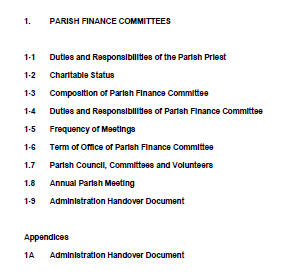
The Guidelines show the inherent ambiguity in language - account and 'The Accounts".
Can. 1287 states that
administrators should render accounts to the
faithful concerning the goods they have given to
the Church. To discharge this duty, the Accounts
(as at 31st December) must be published to the
Parish. The Finance Committee shall advise on
the form and content of the published Accounts.
However, they must show as a minimum the income
and expenditure of the parish for the financial
year (1 January – 31 December). Accounts for the
preceding financial year should be published to
parishioners by 31st March.
The A&B Parish Finance Committees document seen
on their website in 2018 showed the same wording
about Trustees.
A note on their Publication of Parish
Accounts also said:
“Can 1287 states that administrators should
render accounts to the faithful concerning the
goods they have given to the Church. To
discharge this duty, a yearly financial
statement must be made available for all
parishioners. The format of the Parish Financial
Return is suitable.”
However, in the 2020 Guide for Finance
Committees and Parish Accounting Handbook all
reference to Canon 1287.2 has disappeared,
together with the statement of Trustees’
obligation.
The website shows the parish accounts for 2020 and 2019 - one of only two among 40 cathedral parish websites searched in mid-2021 in the UK and New Zealand.
In contrast, for the 78-page Parish Handbook on
the Diocesan website the Trustees approved a
different interpretation of Canon 1287.2.
This
says a Finance Committee should report annually
to the wider parish on the financial situation
of the parish, for example at the AGM of the
Parish Pastoral Council and in the parish
newsletter.
The St John’s guide also has a handy reminder
for all Trustees. “The
parish priest must ensure that an effective
Parish Finance Committee (PFC) is formed and
that all relevant information is made available
to its members. While he is encouraged to
delegate many financial and administrative
matters relating to the parish to people with
relevant expertise, it is his duty to keep
himself fully informed of all material matters
relating to the parish. He must ensure that all
necessary documents are completed accurately and
within the time allowed. He is ultimately
responsible for the administration of the
juridical person – the parish. That
responsibility cannot be delegated.”
By contrast, in the USA the Diocese of
Birmingham has available on-line its Financial
Best Practices Guide: “The
Parish Finance Council should review and assure
that a financial report is issued each year and
made available for parishioners to review.”
Under Internal Controls, one function of the PFC
is “to
prepare and publish an Annual Financial
Statement and Report for the Parish Finance
Council (and Parish Pastoral Council and the
members of the parish community if desired)”.
HRHG Even if they don’t desire, Canon 1287.2
says the priest has to make that report.
East Anglia Diocese Parish Handbook 2020
“The [Finance] committee should report
annually to the wider parish on the financial
situation of the parish, for example at the AGM
of the Parish Pastoral Council and in the parish
newsletter.”