OpenBooks Project
     HOME     GUIDE    C1287.2    SOURCES   SURVEYS     REPORTS     SUGGESTIONS    AOB     AUTHOR     CONTACT
     

 Search  A PAGE ON THE CATHOLIC RANGE
Sources explored - a catholic range


The main sources of information were the websites of Catholic parishes and dioceses - mostly in the United Kingdom, but visited far and wide. Websites are good research material - free to access, available anytime from anywhere without having to trouble anyone for information.

The downside is that they may change - not simply week on week. This was seen with whole make-overs of  the website between the 2018 and 2021 surveys. This meant some crucial content was missing.

Search engines were available on most diocesan and episcopal conference websites. However, their scope was limited at times.  They sometimes misled on parish websites - sometimes none were shown, but Googling unearthed a full website.

Reading around meant some books and on-line journals. 


Most forms of qualitative empirical inquiry have taken a minimalist approach to openness, providing only limited information about the research process, and little or no access to the data underpinning findings. What scholars do when conducting research, how they generate data, and how they make interpretations or draw inferences on the basis of those data, are rarely addressed at length in their published research…it can sometimes take considerable detective work to piece together a picture of how authors arrived at their conclusions.”

In Data Access and Research Transparency in the Qualitative Tradition by Colin Elman and Diana Kapiszewski. Published online by Cambridge University Press: 29 December 2013


“First I shake the whole apple tree, that the ripest might fall. Then I climb the tree and shake each limb, and then each branch and then each twig, and then I look under each leaf.”

Attributed to Martin Luther


The 2018/19 Survey examined the websites of…

  • about 60 episcopal conferences worldwide. The basic list of these is at the Catholic News Agency though these are not always accurate. The Catholic Directory has a truncated version. GCatholic has detailed list, with links to websites.

  • the Oficina de Transparencia of the Conference in Spain, for its data and report on the socioeconomic value of the Church.

  • all 22 dioceses in England & Wales; all 8 in Scotland; all 4 in Northern Ireland; all 6 in New Zealand; all in Chile, Argentina, France; and others.

  • all parishes in 6 dioceses in England & Wales, plus samples in many others.

  • one parish’s on-line offertory data in its on-line newsletters, several years Finance and Pastoral Committee Minutes, and updates on its contribution to a diocesanwide appeal

  • Voice of the Faithful 2017 survey of transparency in all 177 dioceses in the United States

The May-June 2021 Survey examined…


  • the websites of over 1200 parishes/churches in the United Kingdom – all those listed in the dioceses of Portsmouth, Birmingham, Salford, Nottingham, Southwark, Portsmouth, Hexham & Newcastle, Cardiff, Paisley, Aberdeen, Armagh.

    Sometimes the diocese list churches rayher than parishes. Sometimes the list is alphabetical by church or parish name, sometimes by location. Sometimes there are websites for pastoral areas. in theory, the links from the diocesan website should be OK, but this may not be the case.

  • the websites of all 40 Cathedral parishes in the UK and New Zealand

  • annual Mass count returns for individual parishes: Portsmouth 2002-17; East Anglia 2017 and 2019 in their Year Book on-line

  • the Gift Aid data at parish level in Southwark and Brentwood, and for individuals (anonymous) for two years in one parish in Southwark.

  • The latest on-line Trustees Annual Reports and financial statements for all UK dioceses, as shown on the websites of the charity regulators: the Charity Commissions of England & Wales, and of Northern Ireland; the Office of the Scottish Charity Regulator

Other on-line information sources included…

  • Other charity regulators, for diocesan annual reports and accounts on-line:  An Rialálaí Carthanas, the Regulator for Ireland. In New Zealand, individual Catholic parishes are registered with the charity regulator Ngā Ratonga Kaupapa Atawhai who have their key financial information available on-line.

  • The on-line annual reports of about two dozen faith-based charitable organisations, including CofE parishes, chapels, mosques, temples, synagogues.

  • The Voice of the Faithful surveys 2017-20 of on-line financial transparency and accountability in all 177 Catholic Dioceses in the USA.

  • Her Majesty’s Revenues & Customs; National Audit Office; National Census 2011; The Office of National Statistics.

  • The Church of England’s Research & Statistics Unit.

  • National Leadership Roundtable; Association of Fundraising Organisations; Transparency International; National Council of Voluntary Organisations;

  • Pew Research Centre on Religion and Public Life, and other academic units.

  • Catholic and other on-line free-to-view media.

  • MumsNet, a few blogs; some parish Facebook pages; not Twitter.

  • Not on-line: a few e-mails; The Tablet, and a little other press material; books.

“First I shake the whole apple tree, that the ripest might fall. Then I climb the tree and shake each limb, and then each branch and then each twig, and then I look under each leaf.”

Attributed to Martin Luther


  Advocates!

Articles about Canon 1287.2 on the internet proved surprisingly sparse, despite much trawling-through with several search engines. However, in early 2021 two authoritative - and recent - articles surfaced, by priests at the Pontifical University of the Holy Cross in Rome. They’re both in reader-friendly English, btw.
 
Tras las huellas del Nazareno: D. Cristian Mendoza Ovando - YouTube

 "What kind of transparency for the Church? Proposing operational transparency for processes, solutions and decisions in the Catholic Church"


This is by Professor Cristian Mendoza Ovando in the open-access Church Communication and Culture www.tandfonline.com/toc/rchu20/5/2  or  https://santacroce.academia.edu/CristianMendozaOvando

And you can catch him - albeit in Spanish, with subtitles - quite on YouTube, too.


“The Obligation of Transparency in the Administration of Temporal Goods of the Church in Canon 1287.2”

This is Manila-based Fr Robert Young’s 2016 Doctoral Thesis in the Faculty of Canon Law - and helped along by many knowing academic hands, by the look of it. This is recommended as a definitive work on the history, place and importance of Canon 1287.2.  In OpenBooks it’s referred to as the Fr Robert Young Thesis.

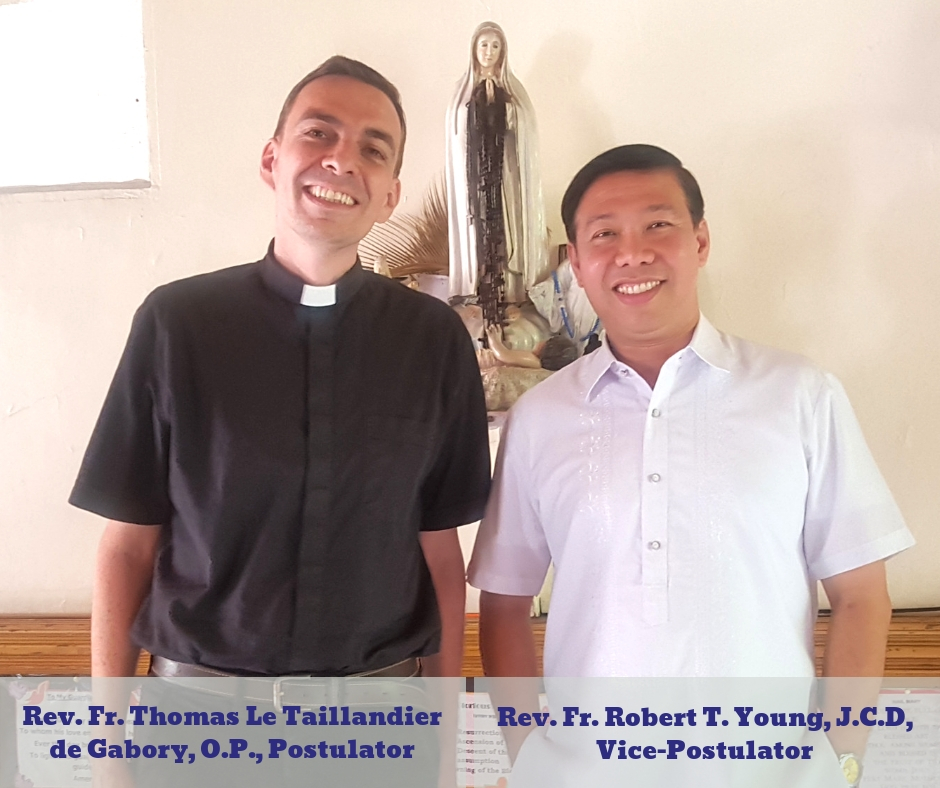
Fr Young is also a Vice-Postulator.  Since April 1983, the Church has appointed Postulators - a person who represents the petitioner in a cause for beatification and canonization. He handles the cause before the diocesan tribunal, and defends the interests of the cause and collaborates with ecclesiastical authorities in the search for truth. So it can be said that the postulator is the spirit or the soul of the process. The Postulator in the case of Darwin Ramos - with the Darwin Ramos Association as the petitioner - is Rev. Fr. Thomas de Gabory, OP, a French Dominican priest from the Dominican Province of Toulouse, with Fr Young as Vice-Postulator. You can see more at https://darwin-ramos.org/postulation-2/

The title suggested the term Expostulator...